The CAREton Project — Used Beverage Carton Recycling
From your MILO carton to a rooftop — The CAREton Project transforms used beverage cartons into durable PolyAl roofing tiles and panel boards, with 8 dedicated drop-off points across Putrajaya managed by DRB-HICOM and AFES.

Overview
The CAREton Project is a nationally recognised circular economy initiative co-led by Tetra Pak Malaysia and Nestlé Malaysia (MILO® UHT) that transforms used beverage cartons (UBCs) into durable, sustainable building materials — specifically PolyAl roofing tiles and panel boards. Since its inception in 2012, the programme has grown into one of Malaysia’s most impactful private-sector-led recycling initiatives.
In Putrajaya, the programme is anchored by 8 dedicated drop-off points managed by DRB-HICOM across six residential precincts, with collection logistics supported by Alam Flora Environmental Solutions (AFES) and integrated into Perbadanan Putrajaya’s (PPj) broader solid waste management ecosystem.
The Problem: Why Cartons Matter
Used beverage cartons — the familiar packaging of MILO, fruit juices, and UHT milk — present a unique recycling challenge. Each carton is a composite material:
| Layer | Material | Composition |
|---|---|---|
| Outer layers | Paper / cellulose fibre | ~75% |
| Middle layer | Polyethylene plastic | ~20% |
| Inner lining | Aluminium foil | ~5% |
This multi-layer construction makes beverage cartons difficult to recycle through conventional single-material streams. Without dedicated collection and specialised processing, these cartons typically end up in landfills — wasting both the embedded paper fibre and the valuable plastic-aluminium composite.
The CAREton Solution: From Waste to Building Material
Step 1 — Flip, Flap, Flat (Consumer Action)
Residents prepare their empty cartons using the simple “Flip-Flap-Flat” method:
- Insert — Push the straw back into the empty pack (or leave the cap on for screw-top cartons)
- Flip — Flip the side flaps upward
- Flap — Press the bottom flap flat
- Flat — Flatten the entire carton to save space before depositing at a drop-off point
Step 2 — Collection at Drop-Off Points (Putrajaya)
Flattened cartons are deposited at any of the 8 designated DRB-HICOM collection points across Putrajaya (see locations below). AFES provides scheduled collection and transport of accumulated cartons to the Tetra Pak processing facility.
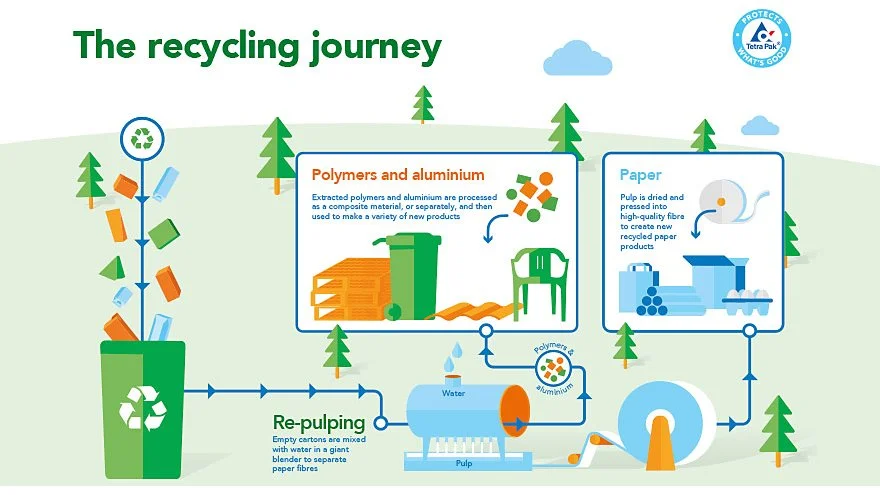
Step 3 — Hydrapulping (Paper Separation)
At the recycling facility, cartons are fed into a hydrapulper — a machine that uses water agitation to separate the paper fibres from the remaining plastic-aluminium composite. The recovered paper pulp is processed into new paper products, completing the paper loop.
Step 4 — PolyAl Manufacturing (The Innovation)
The separated polyethylene-aluminium residue — known as PolyAl — is processed using heat and pressure (hot press technique) to produce solid composite boards. These boards are then cut and moulded into:
- PolyAl Roofing Tiles — Durable, lightweight roof covering for homes and shelters
- Panel Boards — Structural panels for walls, walkways, and community infrastructure
PolyAl Technical Advantages:
| Property | Performance |
|---|---|
| Noise Insulation | Excellent — reduces rain noise significantly |
| Water Absorption | Very low — highly water-resistant |
| Heat Absorption | Low — improved thermal comfort vs. conventional tiles |
| Fire Resistance | Fire-retardant properties |
| Durability | Weather-resistant, UV-stable, long service life |
Putrajaya Drop-Off Network
All 8 collection points are managed by DRB-HICOM and are accessible during operational hours:
| # | Location | Address |
|---|---|---|
| 1 | DRB-HICOM Presint 11 | Pusat Kejiranan Presint 11, Jalan P11/2, Presint 11, 62300 Putrajaya |
| 2 | DRB-HICOM Presint 11 (Mobile) | Jalan P11A, Presint 11, 62300 Putrajaya |
| 3 | DRB-HICOM Presint 14 | Bus Terminal Presint 14, Jalan P14L, Presint 14, 62050 Putrajaya |
| 4 | DRB-HICOM Presint 16 | Apartment Presint 16, Presint 16, 62150 Putrajaya |
| 5 | DRB-HICOM Presint 16 (Pasar) | Pasar Presint 16, Jalan P16G, Presint 16, 62150 Putrajaya |
| 6 | DRB-HICOM Presint 18 | Kompleks Sukan 1Malaysia, Jalan P18F, Presint 18, 62150 Putrajaya |
| 7 | DRB-HICOM Presint 8 | Multi Purpose Hall, Jalan P8D, Presint 8, 62000 Putrajaya |
| 8 | DRB-HICOM Presint 9 | Pusat Kitar Semula Komuniti, Jalan P9B, Presint 9, 62250 Putrajaya |
💡 How to recycle: Flatten your carton using the Flip-Flap-Flat method, bundle in groups, and deposit at any of the above locations. No minimum quantity required.
What Happens After Collection
All cartons collected in Putrajaya are transported by AFES to a Tetra Pak-certified processing facility. The resulting PolyAl roofing materials are donated to underprivileged communities and social welfare projects — with documented use in:
- Orang Asli village homes — replacing aged asbestos or leaking zinc roofing
- Rural school sheltered walkways
- Community surau and utility buildings
As of the latest programme reporting, the Malaysia-wide CAREton initiative has achieved:
- 5,400+ tonnes of used beverage cartons collected
- 450+ million UHT packs recycled
- 1,500+ homes rebuilt or re-roofed with PolyAl materials
Connection to Children-Led Climate Action
The CAREton Project is directly connected to Project 5 of Putrajaya’s Children-Led Climate Change Adaptive Programme — the UBC Collection Competition (2023) — where 308 KG of UBC cartons were collected in a 23-day school competition run by BPMP, Tetra Pak, Nestlé, and AFES. This demonstrates how the programme’s industrial recycling chain is being translated into school-based climate education and community engagement.
PSCB Blueprint Alignment
This initiative is classified under Smart Application 4.4: Waste Management System within the Putrajaya Smart City Blueprint (PSCB), contributing to Thrust 4: Smart Infrastructure & Utilities.
| Framework | Alignment |
|---|---|
| PSCB Smart Application | 4.4 — Waste Management System (Integrated Recycling) |
| Strategic Objective | Waste segregation by category to enhance the recycling rate |
| MSCF Pillar | Smart Environment — Circular Economy & Waste Reduction |
| SDGs | 11 (Sustainable Cities), 12 (Responsible Consumption), 13 (Climate Action), 17 (Partnerships) |
Blueprint Status: Operational — existing private-public partnership programme integrated into PPj’s waste management ecosystem.
Key Highlights
Technology Stack